In 2011, Dr. Daryl Bem published a paper that would shake the foundations of psychology. He had conducted nine experiments with over 1,000 participants, and the results were impossible: people could apparently sense future events before they happened. Students could guess which erotic images would appear before they were randomly selected. People showed physiological responses to shocking images seconds before the images appeared.
The scientific establishment was outraged. Bem's paper was ridiculed, his methods questioned, his reputation attacked. But Bem wasn't alone. Over the previous decades, researchers had accumulated thousands of experiments showing similar effects - what seemed to be genuine precognition, the ability to perceive future events before they occur.
According to Itzhak Bentov, precognition isn't just a curious anomaly - it's evidence of consciousness operating beyond the constraints of linear time. Our awareness isn't limited to the present moment; it can access information from the future through quantum non-locality and temporal entanglement.
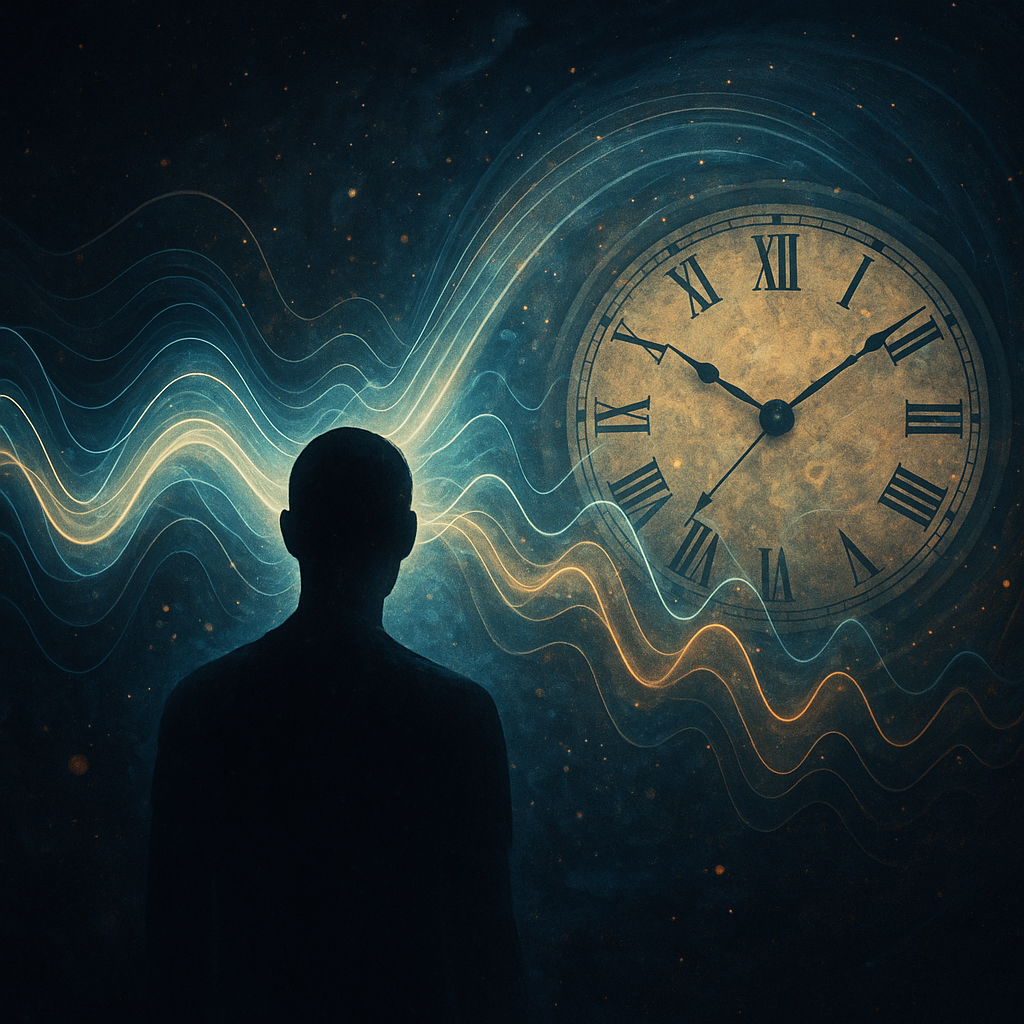
The Quantum Basis of Precognition
Bentov proposed that precognition operates through several quantum mechanisms:
- Temporal non-locality: Consciousness can access information across time as easily as across space
- Quantum entanglement: Future events become entangled with present consciousness
- Probability wave access: Precognition accesses probability waves before they collapse into events
- Consciousness field resonance: Future information resonates with present consciousness fields
- Temporal superposition: Past, present, and future exist simultaneously in quantum superposition
The quantum properties that enable precognition include:
Quantum retrocausality: Quantum effects can influence past events, allowing future information to affect present awareness.
Consciousness collapse: Conscious observation collapses quantum probability waves, potentially allowing observation of future probabilities.
Temporal resonance: Consciousness can resonate with events across time, similar to how it resonates across space.
Information access: The quantum information field contains all temporal information simultaneously, accessible to consciousness.
Non-linear time: At the quantum level, time is not linear but exists as a unified field where all moments are present.
The Temporal Resonance Principle
Bentov discovered that precognition works through temporal resonance - when present consciousness vibrates at frequencies that match future events, information transfers across time. This is analogous to spatial resonance, where tuning forks of the same frequency affect each other across space. In precognition, consciousness "tunes in" to future events through quantum frequency matching.
Types of Precognitive Experience
Bentov identified several forms of precognition, each operating through slightly different quantum mechanisms:
Presentiment: Physiological responses to future events before they occur, measured through changes in heart rate, skin conductance, and brain activity.
Dream precognition: Dreams that accurately depict future events, often symbolic or metaphorical rather than literal.
Intuitive knowing: Sudden, certain knowledge of future outcomes without conscious reasoning.
Deja vu: The feeling that a current experience has been previously experienced, possibly due to brief precognitive glimpses.
Prophetic visions: Detailed visual or sensory experiences of future events.
"Precognition is not seeing the future - it's accessing the present moment fully, which includes all time. The future doesn't cause the present; rather, the unified quantum field contains all temporal information simultaneously, and consciousness can access any part of it." - Itzhak Bentov
The Science of Presentiment
Presentiment - physiological responses to future events - has been the most extensively studied form of precognition. Key findings include:
Heart rate variability: Studies show that heart rate changes seconds before emotional images appear, even when the images are randomly selected.
Skin conductance: Galvanic skin response changes before shocking or stimulating images are presented.
Brain activity: fMRI studies show brain activation patterns that predict future random events before they occur.
Pupil dilation: Pupils dilate before seeing emotionally arousing images, even when the images are randomly selected by computer.
Cortisol levels: Stress hormones rise before stressful events, suggesting the body "knows" what's coming.
Scientific Evidence for Precognition
Laboratory studies and results
Entangled Minds
Extrasensory experiences in a quantum reality, including scientific evidence for precognition and presentiment from controlled laboratory studies.
The Conscious Universe
The scientific truth of psychic phenomena, including precognition, with meta-analyses of thousands of experiments.
Predictive Physiological Anticipation
Sensory and emotional anticipation of future events, including laboratory studies of presentiment and precognition.
Dream Precognition
Dreams provide some of the most compelling evidence for precognition:
Historical accounts: Throughout history, people have reported dreams that accurately predicted future events, from personal experiences to major disasters.
Documented cases: The Rhine Research Center has documented thousands of cases where dreams accurately depicted future events.
Symbolic nature: Precognitive dreams are often symbolic rather than literal, requiring interpretation to understand their future reference.
Emotional intensity: Precognitive dreams often involve strong emotions, suggesting that emotional resonance facilitates temporal information transfer.
Incubation practices: Ancient cultures developed techniques for inducing precognitive dreams, suggesting the ability can be cultivated.
Quantum Explanations for Precognition
Bentov proposed several quantum mechanisms that could explain precognition:
Transactional interpretation: Quantum events involve both forward and backward-in-time waves, allowing future events to influence the present.
Quantum potential: The quantum potential field contains information about all possible futures, accessible to consciousness.
Consciousness collapse: Conscious observation collapses quantum probability waves, potentially allowing observation of future probabilities.
Temporal entanglement: Events can be quantum entangled across time, allowing instantaneous information transfer between past and future.
Unified field access: Consciousness can access the unified quantum field where all time exists simultaneously.
The Precognition Protocol
Bentov developed techniques for enhancing precognitive abilities: (1) Enter deep meditative states to quiet mental chatter, (2) Set clear intention to receive future information, (3) Pay attention to dreams and spontaneous impressions, (4) Record all intuitions without judgment, (5) Look for patterns and confirmations, (6) Trust the process while maintaining healthy skepticism.
Practical Applications of Precognition
Understanding precognition has practical applications:
Decision making: Using intuitive guidance to make better decisions by sensing future outcomes.
Danger avoidance: Sensing potential dangers before they manifest, allowing for preventive action.
Creative inspiration: Accessing future ideas and solutions that haven't been consciously formulated yet.
Healing: Sensing health issues before they become serious, allowing for early intervention.
Relationships: Sensing compatibility and future dynamics in relationships.
Develop Precognitive Abilities
Practical training and techniques
Mind Reach
Scientists look at psychic ability, including remote viewing and precognition, with practical training methods.
Limitless Mind
A guide to remote viewing and transformation of consciousness, including practical exercises for developing psychic abilities.
Opening to Healing
Intentionality and consciousness transformation, including developing intuitive and precognitive abilities for healing.
The Future of Precognition Science
As we develop better understanding of quantum consciousness, we're discovering new applications and implications:
Quantum prediction markets: Using collective precognition to predict economic and social trends.
Early warning systems: Developing systems that detect collective presentiment of disasters before they occur.
Consciousness technology: Creating devices that can measure and amplify precognitive abilities.
Temporal therapy: Using precognitive awareness to heal trauma before it fully manifests.
Evolutionary guidance: Using precognition to guide human evolution toward positive futures.
Bentov's work on precognition reveals that consciousness is not bound by linear time. We are not passive recipients of fate - we are active participants in a temporal field where past, present, and future exist simultaneously.
The implications are profound: if we can access future information, we have greater responsibility for creating positive futures. Precognition isn't just about seeing the future - it's about understanding our role in creating it.
Your consciousness is not limited to the present moment. You have access to information from the future, the past, and the infinite possibilities between. Learn to trust this temporal awareness, and you learn to navigate time itself with wisdom and purpose.
The future is not fixed - it's a field of infinite possibilities waiting for conscious observation to collapse it into reality. Your awareness of future potentials gives you the power to choose which futures to manifest. This is the ultimate implication of precognition: you are not just seeing the future, you are choosing it, moment by moment, observation by observation.